Learning ecosystems, knowledge systems, research, and operational design across Moore, Proofpoint, and Ibotta.
01
MOORE · SYSTEMS INFRASTRUCTURE · 2025—PRESENT
Moore to Learn
Moore’s first enterprise learning ecosystem, built from zero and designed for 3× growth.
1.4k+learners79%participation
→02
PROOFPOINT · TRAINING OPERATIONS · 2023—2024
Cybersecurity Academy
Reusable operations for one of cybersecurity’s largest external education platforms.
90k+learners810+cases resolved
→03
IBOTTA · KNOWLEDGE SYSTEMS · 2023
Link Library
A role-based resource system that centralized scattered links and reduced information friction.
350+resourcesBuiltto last
→04
IBOTTA · GROWTH STRATEGY · 2023
Building the Business Case for Spanish at Ibotta
Turned social-media workarounds and user demand into a cross-functional growth recommendation.
3,000organic referrals4partner teams
→
MOORE · LEARNING OPERATIONS · 2025—PRESENT
Moore to Learn
Translating executive vision into scalable operational infrastructure—Moore’s first enterprise learning ecosystem, built from zero.
ROLETraining Coordinator → L&D Program ManagerTIMELINEApril 2025—PresentSCALE1.4k+ learners Built toward ~4,000
1.4k+ active learners24k course completions79% participation4.6/5★★★★★★★★★★avg. course rating81 contributing SMEs43% on AI content
THE SYSTEM VIEW
Turning many moving parts into one operating model.
INPUTS
ENTERPRISE LEARNING ECOSYSTEM
OUTPUTS
ABSORB LMS · EXPERIENCE DESIGN & ADMINISTRATION
The front door to enterprise learning.
I manage the full LMS experience—from visual design and homepage configuration to catalog architecture, automation, learner support, reporting, and ongoing administration. This portfolio-native recreation shows how the live Moore to Learn homepage is structured.
Explore the work, the learning, and the outcomes behind it.
AI LEARNING HUBUNLOCK THE POWER OF AI
Courses from foundations to hands-on tools.
MOORE TO LEARNOne place to keep growing.
Find courses, curricula, transcripts, and manager tools.
Featured CoursesCURATED & CONFIGURED IN ABSORB LMS
CLIENTSWhat We Do for ClientsOnline course · 27mCOMPLETED ✓DATAAnalytics for MarketersOnline course · 38mCOMPLETED ✓XMicrosoft Excel 365Curriculum · 6 coursesIN PROGRESSAICopilot BasicsCurriculum · 5 coursesIN PROGRESSSTORYStorytelling That Drives GrowthOnline course · 55mCOMPLETED ✓
DESIGNEDCONFIGUREDAUTOMATEDADMINISTEREDBY SARA
01 · THE CONTEXT
A vision without an operating system.
Moore is a large professional services organization operating across multiple business units. When I joined in April 2025, it had no centralized enterprise learning ecosystem. Knowledge transfer was fragmented. Onboarding was inconsistent. There was no shared infrastructure for how employees learned, developed, or accessed training.
There was a vision for one—but no platform, no governance, no operational infrastructure, and no clear path from idea to execution. My first day, I was pulled directly into the enterprise platform evaluation that led to Absorb LMS. That set the pace for everything that followed.
02 · THE SYSTEM
Six layers, designed as one ecosystem.
I evaluated five enterprise learning platforms against a custom requirements matrix covering functionality, scalability, integrations, and organizational fit. Absorb LMS scored highest for where the program needed to go: the same architecture supporting 1.4k+ active learners today was designed to scale toward roughly 4,000 without a platform change.
01Platform
Absorb LMS, SSO, and employee data mapping.
02Data backbone
Credits, completions, course shells, and transcript integrity.
03Workflows
Content intake, Jira roadmap, approvals, QA, and publishing.
04Visibility
Executive dashboards with biweekly, monthly, and quarterly rhythms.
05Governance
Contributor standards for 81 SMEs and a 40-credit model.
06Adoption
Onboarding, AI-assisted course design, and learner experience.
ENTERPRISE 40-CREDIT MODEL
A company-wide requirement turned the LMS into operating infrastructure.
For the first time, Moore had an annual learning requirement across the organization. That meant Moore to Learn needed to do more than host courses — it had to track progress, preserve transcript integrity, support external training, recognize learning contributors, and give managers a clear view of team pacing.
Credit matched the person’s role.Employees could earn credits by completing learning, or by creating, facilitating, or supporting approved learning experiences. The governance layer kept totals credible without flattening different kinds of contribution.
03 · FEATURED BUILD
Passport to Moore: onboarding infrastructure for One Moore.
Less than six months into the role as a Training Coordinator, I helped move Passport to Moore from a cross-functional onboarding concept into the standard onboarding curriculum for all new Moore employees. The program launched on October 15, 2025 and now gives new hires a consistent introduction to Moore’s structure, client work, tools, culture, and ways of working across 40+ business units.
The work was not just course assembly. I bridged HR, Communications, HRIS, senior operational stakeholders, and Moore to Learn ownership to turn a SharePoint/Sway prototype into a governed Absorb LMS curriculum with enrollment logic, course grouping, competency-based stamps, certificates, transcript visibility, evaluation data, and reporting.
The original passport concept stayed intact: learners move through tours and earn stamps. I translated that experience into Absorb LMS functionality using curriculum structure, competencies, completion logic, certificates, and transcript visibility.
New hires are enrolled automatically.
I configured the enrollment rules and partnered with HRIS so that when a new employee is created in UKG, the Moore to Learn account is created and the Passport curriculum enrollment rules kick off automatically.
Built across the org, not around it.
HR shaped the onboarding need, Communications supported the employee-facing tone and content, HRIS enabled the employee data connection, senior stakeholders defined what new hires needed to understand, and Moore to Learn became the operational home.
Launch was V1, not the finish line.
V2 is framed as product maturity: use leadership discussions, HR feedback, stakeholder input, course evaluations, and learner data to revisit the curriculum and improve the next version. That strengthens the story because it shows the program has a feedback loop.
Partnered with Moore’s Legal team to convert the Information Transparency & Reporting Policy into a mandatory, simulation-based Moore to Learn course for a defined covered-leader audience. I used an AI-assisted workflow to shape the course structure, then built the learner experience with policy context, FAQs, knowledge checks, scenario practice, and supporting resources.
Behind the course, I worked with HRIS to map a covered-leader field into Moore to Learn so enrollments could run automatically instead of being manually maintained. I configured the required-course setup, 30-day due date, Absorb LMS reminder emails, and completion visibility, then built reporting access for Legal and HR to monitor progress and follow up with anyone lagging.
Policylegal requirement→Courselearner experience→Rulesaudience + due date→ReportingAbsorb Analyze
All responses201Covered leader responses112Overall rating4.57Content relevance4.58
Written responses surfaced for Legal review
“The link to the email template was a nice touch.”
“The course itself was very easy to understand and well put together.”
“This course was very valuable.”
05 · MANAGER VISIBILITY
Visibility that scales with the requirement.
Once the 40-credit requirement was in place, managers needed more than a transcript export. They needed a reliable view of team progress, credit totals, completion history, pacing, and exceptions across standard LMS courses and nontraditional learning activity.
The native Absorb LMS manager experience dashboard did not show external credits, inactive course shells, historical completions, or enough transcript context. I built a manager-facing reporting workbook that connects Absorb LMS users, enrollments, credits, and manager roster data.
A custom VBA macro pulls the full roster and course data, splits it by manager, removes every internal view an individual manager should not see, saves a standalone workbook, and drafts an Outlook email with the correct file attached. The workflow protects data while turning a highly repetitive process into reusable infrastructure.
Built once. Distributed to 300+ managers.With generation and send status visible in the same operating workflow.
TEAM MEMBERS14PARTICIPATION86%CREDITS EARNED438ON TRACK12 / 14
Annual learning progress86%
Illustrative anonymized team data · select a row to view course history
EMPLOYEE
JOB TITLE
HIRE DATE
2026 REQUIREMENT
CREDITS EARNED
EXPECTED TO DATE
% OF REQUIREMENT
PACE STATUS
COMPLETIONS
LAST COMPLETION
LEARNER
CONTRIBUTOR
Alex Rivera
Sr. Account Manager
1/3/2022
40.00
22.00
20.00
55%
Ahead of pace
7
6/29/2026
19.00
3.00
COURSE HISTORY · ALEX RIVERAAI Essentials for Marketers Completed4.00 credits · 6/29/2026Data Privacy & Compliance 2026 Completed2.00 credits · 6/10/2026Strategic Account Management Completed5.00 credits · 5/22/2026Inclusive Leadership Series Completed4.00 credits · 4/14/2026
Jordan Lee
Account Manager
3/15/2021
40.00
21.00
20.00
53%
On track
7
6/5/2026
19.00
2.00
COURSE HISTORY · JORDAN LEEClient Workshop Facilitation Completed3.00 credits · 6/5/2026Moore Culture & Values 2026 Completed1.00 credit · 5/18/2026Excel for Analytics Completed3.00 credits · 4/29/2026
Morgan Patel
Strategy Analyst
6/1/2023
40.00
15.00
20.00
38%
Slightly behind
6
6/24/2026
14.00
1.00
COURSE HISTORY · MORGAN PATELData Storytelling Completed4.00 credits · 6/24/2026Foundations of Consulting Completed3.00 credits · 5/9/2026
Casey Kim
Account Manager
8/12/2024
40.00
16.00
20.00
40%
Slightly behind
5
6/22/2026
16.00
—
Taylor Brown
Senior Analyst
2/7/2022
40.00
15.00
20.00
38%
Slightly behind
7
6/20/2026
13.00
2.00
Each exported workbook contains only this manager’s team. Internal controls and raw-data tabs are removed before distribution.
06 · IMPACT
From standing start to a durable learning model.
The 40-credit model gave Moore to Learn an enterprise operating rhythm: employees had a clear annual expectation, managers had a way to track progress, and leadership had a more consistent view of learning adoption across the organization.
79% participation is a meaningful adoption signal from a standing start. A 4.6 average course rating reflects content quality, not just completions. The 40-credit enterprise model gave the program a clearer annual rhythm, while governance made it possible for 81 contributing subject matter experts to participate instead of concentrating the work in one role.
ACTIVATION~230 → 1.2k
users enabled from limited Data Pillar release to Professional Services rollout.
COURSE VELOCITY0 → 88
Moore-authored courses in ten months. Grew contributor network from 0 to 81.
ACCELERATION5×
completion growth in four months.
MOORE TO LEARN · OPERATING DASHBOARDGrowth from launch
JUL 2025—MAY 2026
1.4k+ enabled users24k completions361 active courses
LAUNCHSSO40-CREDIT MODELNOW
PROOFPOINT · TRAINING OPERATIONS · 2023—2024
Cybersecurity Academy
Training operations at enterprise scale—an LMS migration, AI chatbot knowledge architecture, and the documentation infrastructure that kept everything running.
ROLETraining Operations InternTIMELINEOctober 2023—December 2024SCALE90k+ global learners
Proofpoint’s Cybersecurity Academy served 90k+ learners across enterprise customers, channel partners, and internal teams. Support workflows, documentation, migration communications, and knowledge access needed stronger infrastructure to operate consistently at that scale.
90k+ learners · 810+ cases · 95% renewal rateThe numbers belong inside the operating story, not in a separate carousel.
02 · DAILY OPERATIONS
Turning high-volume support into operational knowledge.
As the first point of contact for training, enrollment, certification, and platform inquiries, I resolved 810+ Salesforce cases over 14 months. The work exposed repeatable patterns that became process guides and support resources, reducing reliance on tacit knowledge.
I also contributed to testing, configuration, and learner communications for the migration from Skilljar to Adobe Learning Manager, affecting 90k+ users globally.
OPERATIONS AT A GLANCEFrom individual cases to reusable infrastructure
I contributed to the migration from Skilljar to Adobe Learning Manager through platform testing, configuration support, learner communications, and day-to-day issue resolution. The migration touched a global audience of 90k+ learners across customers, partners, and internal teams.
01TEST
Validate learner and admin workflows.
→
02CONFIGURE
Support platform and program setup.
→
03COMMUNICATE
Segment guidance for affected audiences.
→
04STABILIZE
Resolve access, enrollment, and certification issues.
Recurring support patterns became source material for clearer enablement. I developed FAQs, learner communications, certification resources, and workflow guidance that helped customers and internal partners complete tasks without relying on one-off explanations.
LEARNERAccess & enrollment guidance
Reduced ambiguity around platform entry and next steps.
CERTIFICATIONLaunch & badge resources
Supported 10+ certification launches and Credly workflows.
INTERNAL TEAMSReusable operating guidance
Connected training delivery, customer success, and support.
05 · SCRIBE DOCUMENTATION SYSTEMS
Capturing the process while doing the process.
I used Scribe to turn high-friction workflows into visual, step-by-step guides for enrollment, certification, support, and platform administration. The guides were distributed through the systems teams already used—including Confluence, SharePoint, Seismic, and Salesforce Community—so documentation lived where work happened.
GUIDE 02Certification support path9 STEPS · ACTIVE
GUIDE 03Platform administration SOP18 STEPS · ACTIVE
GUIDE 04Escalation & case routing7 STEPS · UPDATED
06 · KNOWLEDGE ARCHITECTURE
Documentation one step ahead of the ask.
I developed 75+ knowledge documents for an internal AI chatbot—conversation flows, FAQ scripts, and support use cases that formed its operational core—and built 15+ cross-functional process guides spanning support, training delivery, and customer success.
“Sara had put together extensive documentation—she was usually one step ahead of every ask.”Kate O’Keefe · Cybersecurity Academy Community Manager
07 · CHANGE COMMUNICATIONS
Making platform change legible.
For the rebrand from Level Up to Cybersecurity Academy, I co-led communications reaching customers, partners, and internal teams. I wrote segmented campaigns and the FAQ distributed across internal channels. Alongside support and certification operations, that infrastructure contributed to a 95% renewal rate across 45 accounts and supported 10+ certification launches.
CASE STUDIES / BUILDS
Small systems. Real leverage.
Discrete tools, dashboards, AI workflows, and operational infrastructure built to remove recurring friction.
KNOWLEDGE SYSTEM
Link Library
Centralized hundreds of scattered team resources with role filters, audit dates, and maintenance workflows.
Faster onboarding & resource access
Google SheetsApps Script
DASHBOARD
Manager Learning Dashboard
Automated 300+ privacy-safe manager reports from one structured learning data model.
300+ reports without manual exports
ExcelVBAOutlook
AI SYSTEM
Course Builder Workflow
Transforms raw SME material into structured outlines, objectives, and first-draft course assets.
Faster structured drafts
ClaudePrompt Design
AI SYSTEM
Quiz Generation Workflow
Produces complete quiz questions with tailored feedback for every answer choice and SME review.
Consistent assessment design
ClaudeLearning Design
LEARNING OPS
LMS Evaluation Framework
Scored five platforms against functionality, integrations, scalability, and organizational fit.
Informed Absorb LMS selection
RequirementsVendor Analysis
WORKFLOW
Credit Governance System
Architected credit assignment, tracking, and compliance reporting for an annual 40-hour requirement.
Built once for full-scale rollout
Absorb LMS
DASHBOARD
Learning Analytics
One reporting layer serving executive, HR, Legal, and Communications stakeholders.
Four audiences, one source of truth
Absorb AnalyzeData Design
DOCUMENTATION
Process Documentation
Scribe-based systems for enrollment, onboarding, support, and platform administration.
Lower support friction
Scribe AIConfluence
AI AGENT
Absorb LMS Copilot
A reusable assistant for platform architecture decisions, troubleshooting, and admin workflows.
Faster admin resolution
CopilotLMS Operations
AI AGENT
Presentation Feedback Agent
Evaluates facilitator recordings and transcripts against a structured coaching framework.
Clearer, more consistent coaching
ClaudeStructured Evaluation
KNOWLEDGE SYSTEM
AI Knowledge Repository
Connects course assets, feedback, reporting, and contributor metadata for AI-assisted retrieval.
Reusable institutional memory
SharePointCopilotMetadata
AI AGENT
Course Evaluation Intelligence
Turns raw evaluations into structured reports with trends, ratings, response context, and improvement signals.
Faster quality-review cycles
Claude
WORKFLOW
Operational Intake Systems
Replaced informal content and external-credit requests with visible intake and approval workflows.
Cleaner throughput and ownership
JiraFormsPower Automate
LEARNING OPS
Catalog & Transcript Workaround
Separated active catalog content from inactive credit shells without breaking transcript integrity.
Cleaner learner navigation
Absorb LMSTaggingGovernance
ENABLEMENT
Onboarding & Knowledge Transfer
A sequenced 30/60/90 ramp with hands-on platform practice and repeatable workflow ownership.
New team member owning real requests
ScribeCoachingDocumentation
AI EXPERIENCE
Moore AI Catalog (MAC)
Prototype v3 of a curated AI workflow library for discovering, replicating, and contributing proven use cases across Moore.
Searchable AI workflow library
Absorb LMS
AI AGENT
Newsletter Agent
Built a reusable prompt-and-template workflow for Lean into Learning, a targeted Moore to Learn liaison newsletter. The system turns monthly training updates into branded HTML email issues with consistent structure, issue metadata, color-strip styling, stakeholder intro copy, course announcements, and admin updates.
The workflow helps convert scattered updates into an on-brand communication package that can be reused month over month instead of rebuilt from scratch.
Matches external completion records to Absorb LMS users through name and email cross-referencing, standardized upload files, QA sheets, and a master variation file for known employee name/email patterns.
Built to solve inconsistent external training files with nicknames, maiden names, misspellings, mismatched emails, and formatting issues that previously made reconciliation slow and error-prone.
30%+ less manual reconciliation · 92% match confidence
Absorb LMSQA SheetsName Matching
ONBOARDING
Donor Ambassador Enablement Portal
Building a tailored LMS-within-the-LMS for role-specific onboarding. Using Absorb LMS custom department templates, I am creating a segmented Donor Ambassador experience with customized theming, visibility rules, curated course placement, and a focused onboarding path.
I am also converting one-off onboarding recordings into reusable interactive e-learning in Absorb Create, using an AI-assisted workflow to extract source content, structure learning objectives, create quizzes and scenarios, and generate tailored feedback for correct and incorrect answers.
Reusable onboarding infrastructure for future cohorts
Transformed a SharePoint/Sway onboarding prototype into a structured Absorb LMS curriculum with tours, competency-based stamps, completion logic, certificates, and transcript visibility.
Standardized new employee onboarding
Absorb LMS
COMPLIANCE
Interactive Legal Policy Course
Translated a static reporting policy into scenario-based learning with automated enrollment, covered-leader audience logic, FAQs, knowledge checks, due-date rules, reminder emails, and reporting visibility for Legal and HR.
Removed manual compliance tracking
Absorb LMSScenario DesignPolicy Training
IBOTTA · KNOWLEDGE SYSTEMS · 2023
Link Library
Built a scalable internal resource system despite limited tooling and loosely defined requirements—creating structure before formal ownership existed.
ROLEClient Partnerships InternTIMELINEJune—September 2023SCOPEKnowledge systems · onboarding · proposal support
350+ resources centralized1 shared system3 role-based views1+ year still in use13 resource sections100% audit ownership
01 · THE CONTEXT
The work did not need another static spreadsheet.
The Client Partnerships team operated with hundreds of tools, portals, reports, and links spread across individual bookmarks, Slack messages, and whoever happened to know where something lived. Teams were wasting time searching and new hires had no reliable starting point.
I built a centralized resource library in Google Sheets with 350+ curated links, role-based filters, automated sorting through Apps Script, audit tracking, and maintenance workflows for outdated resources.
02 · INTERACTIVE RECREATION
Explore the system.
This working recreation uses real structure and representative entries from the original Link Library export. It mirrors the directory, role pages, filtered resource views, request workflow, and protected mastersheet.
?
HOW-TO-NAVIGATEThree ways to find what you need
01Choose a view
Start with All Resources, Top Resources, or your role-specific page.
02Search + filter
Narrow by keyword, resource type, site, or team role.
03Request an addition
Submit a link for PDA review instead of editing protected cells.
Team members submit what they know; the PDA owner validates category, role, access, and audit metadata before publishing.
LINE OF BUSINESSRetail AffiliateROLEAE / PSM / PDARESOURCE NAMENew resource requestREQUESTED BYTeam member
DIRECTORYOne front door to every view
The directory separates comprehensive, role-specific, tool-specific, and governance views so people do not need to understand the mastersheet structure.
All ResourcesTop ResourcesAE ResourcesPSM ResourcesPDA ResourcesLookerModeTemplatesCase StudiesRequest SheetProtected Mastersheet
TYPERESOURCEROLESITE
12 resources shownLAST AUDITED · AUG 2023 · SARA
03 · THE GOVERNANCE LAYER
Findability was only half the system.
The library used one protected mastersheet as its source of truth. Role-specific pages and resource views pulled from that source, while a request sheet created a controlled path for additions. Audit dates and ownership made stale links visible instead of letting the system quietly decay.
01Submit
Team requests a new resource.
→
02Review
PDA validates role and category.
→
03Publish
Mastersheet feeds filtered views.
→
04Audit
Owner and review date stay visible.
IBOTTA · GROWTH STRATEGY · 2023
Building the Business Case for Spanish at Ibotta
How a summer internship project began with social listening—and became a cross-functional case for language support, creator partnerships, and targeted market visibility.
Every summer intern at Ibotta needed to choose and complete an independent project. At first, I was stumped. I was also taking a social-media marketing class that summer, so I did what I naturally do when I need ideas: I looked at what people were already saying and making.
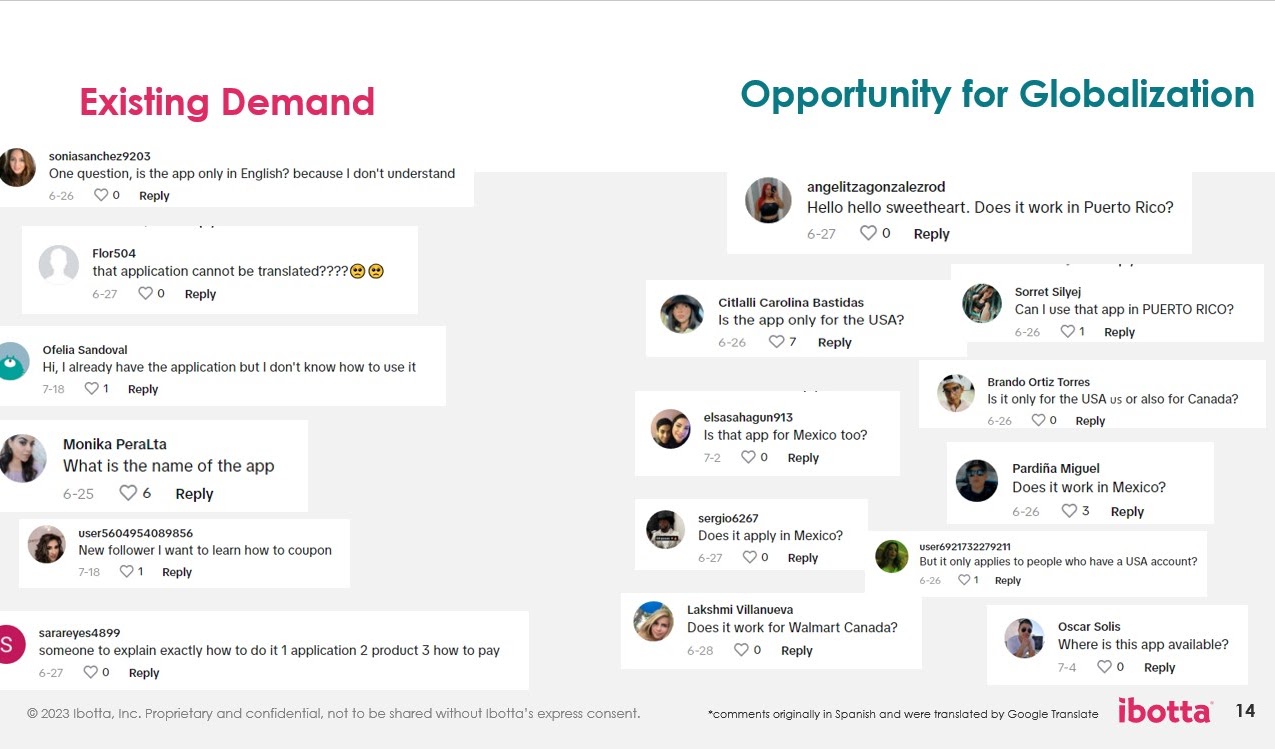
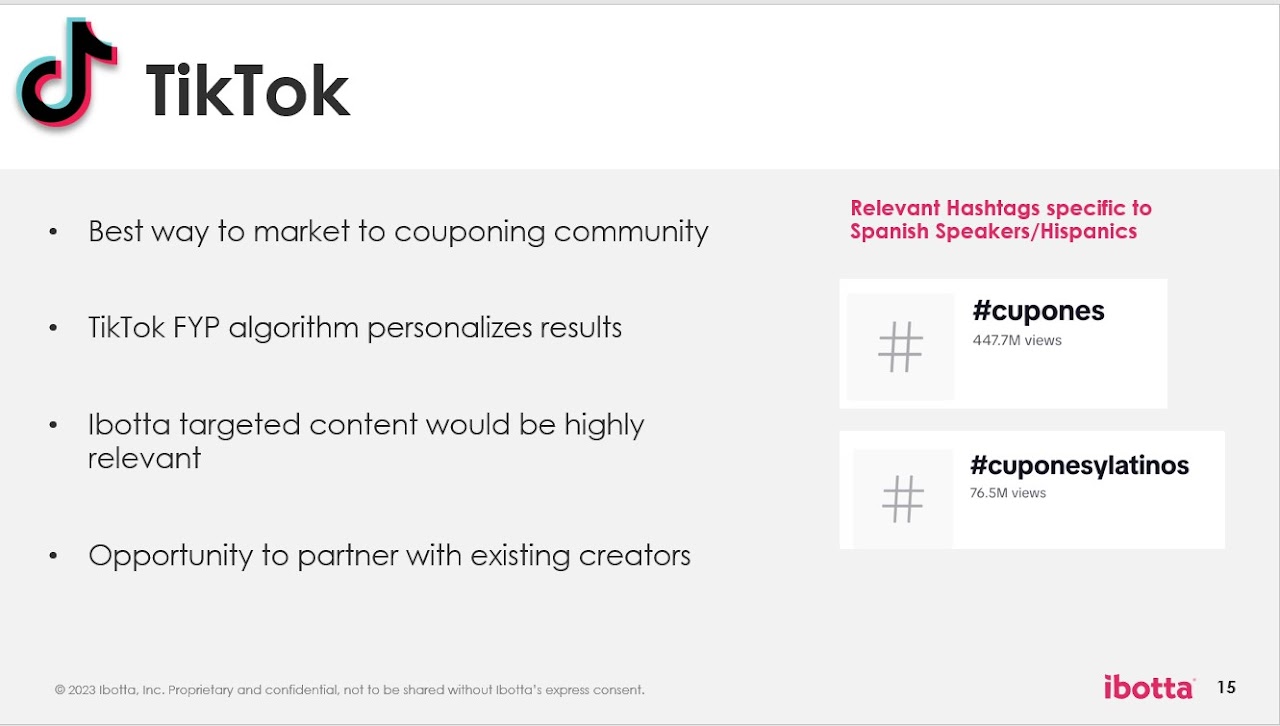
I searched for Ibotta across social media and found something unexpected. Bilingual creators on TikTok and YouTube were making tutorials for Spanish-only speakers—teaching people how to navigate and use an English-only app. The comments underneath those videos were full of questions about translation, availability, and how to get started.
THE STARTING QUESTIONIf users and creators are already bridging the language gap themselves, what opportunity is the product leaving on the table?
02 · THE OPPORTUNITY
Demand was visible before the product supported it.
Ibotta had an opportunity to better serve Hispanic and Spanish-speaking consumers, but the business case needed more than a general recommendation. I assembled evidence across market growth, app-store positioning, user comments, competitor behavior, and creator-led education.
The clearest pattern: people were asking for translation, asking where the app worked, and relying on bilingual creators to learn a product that was still available only in English.
Existing demand + globalization opportunity. Spanish-language comments were scraped, translated, and grouped into recurring user needs.
03 · RESEARCH METHOD
Qualitative signals, made legible at scale.
I drew from academic market research completed through the Honors College at UTA and partnered across Ibotta to connect customer signals to business feasibility. Using Octoparse, I scraped comments from YouTube and TikTok, exported them into Excel, and used translation formulas to analyze Spanish-language feedback at scale.
D2C ESPAÑOL
Language implementation, competitor strategies, marketing opportunities, and user feedback.
MARKET RESEARCH
Demand among current and potential users, market growth, and demographic context.
CONSUMER INSIGHTS
Hispanic users’ needs, shopping behavior, and app-usage patterns.
UX
Feasibility and experience considerations for multi-language support.
For future implementation, I recommended AI-assisted translation with subject matter experts reviewing accuracy, tone, and cultural fit before release.
04 · THE BUSINESS CASE
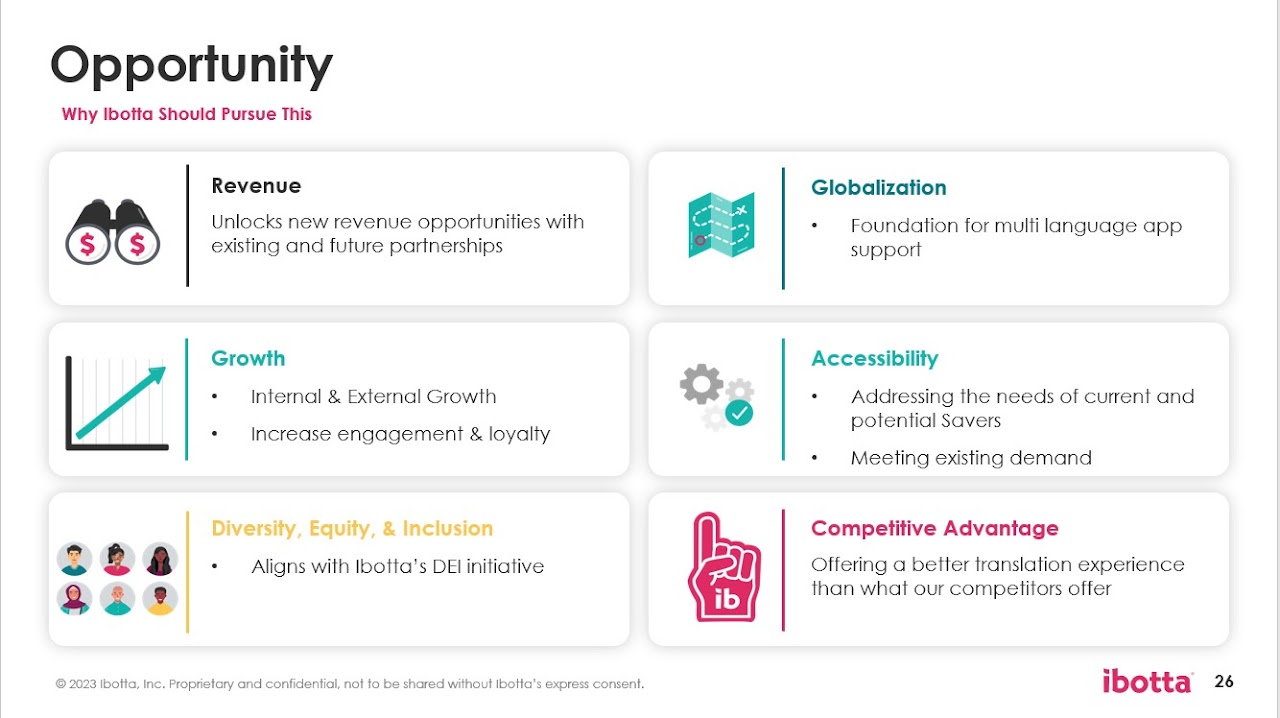
Six reasons this was bigger than translation.
The recommendation connected language support to measurable company priorities—not just localization. It framed Spanish support as an engine for revenue, growth, accessibility, inclusion, and competitive positioning.
05 · CREATOR & CHANNEL SIGNAL
One video. 3,000 organic referrals.
A bilingual TikTok creator was already helping Spanish-only speakers navigate Ibotta while the app remained English-only. One “How you can save with Ibotta” tutorial generated 3,000 organic referrals—clear evidence that demand existed and users were solving the accessibility gap themselves. I also used a second creator tutorial from the same creator as supporting research.
ORGANIC OUTCOME3,000referrals from one creator video
User-led education became the proof point for a broader product and marketing opportunity.
06 · RESULTS & IMPACT
From user signal to visible market action.
I delivered an executive presentation translating market data, user evidence, and competitor analysis into recommendations for product support, creator partnerships, and targeted visibility.
For near-term reach, I researched high-impact podcasts and recommended Yo Quiero Dinero, which was selected for a paid feature. The initiative also contributed to a broader focus on Spanish-speaking consumers and informed two Spanish-language commercials: Seguro que lloverá on January 1, 2024 and Muestra gratis on April 18, 2024.
Research becomes valuable when someone can act on it.
This project sharpened my ability to combine academic research, user evidence, and cross-functional expertise into a business case. The strongest insight was not simply that Spanish-language support mattered—it was that demand was already expressing itself through comments, workarounds, referrals, and creator behavior.
FIND THE SIGNAL→MAKE IT LEGIBLE→CONNECT IT TO STRATEGY→GIVE LEADERS A NEXT MOVE
TESTIMONIALS · THE RECEIPTS
What collaborators say about the work.
Direct, unedited feedback from the people who have built, shipped, and solved problems alongside me.
PROJECT FEEDBACK · 01 / 13
ON THE RECORD · 01
“Sara was constantly looking for optimizations, and brought many meaningful improvements to our operations and customer experience.”
THAD NEWTONSenior Director, Technical Training Operations · Proofpoint
“
● ○ ○ ○ ○
ABOUT SARA
I like the moment when a foggy idea becomes something you can touch.
My work lives between structure and play. I’m happiest untangling an ambiguous problem, finding its human center, then building the clearest version I can.
Then comes my favorite part: putting it in front of people, watching how they react, and collaborating toward the next version. I think about the work a lot like product development—V1, V2, V3—each round making the idea more useful, more intuitive, and more real.
“Just make it exist first. You can make it good later.”
That belief has shaped learning ecosystems, knowledge systems, AI workflows, and operational programs across Moore, Proofpoint, and Ibotta. Outside work, I enjoy reading, traveling, and trying new things that usually become projects.
University of Texas at Arlington · Honors College Minor in English
CERTIFICATIONSFoundations of Project Management
Google
Claude 101
Anthropic
CURRENTLYL&D Program Manager
Moore · Leading the continued expansion of Moore to Learn
HOW I APPROACH THE WORK
field notes
How I make invisible systems visible.
I’m usually pulled toward the places where work is happening, but the system around it is hard to see: the owner is unclear, the data is scattered, or the process only works because one person remembers the steps.
Click a field note to open the system notes.
Input signals
What tells me there’s a system problem?
These are usually symptoms of an invisible system asking to be mapped.
repeated questions
work living in someone’s head
reporting that answers the wrong question
a process held together by messages
unclear ownership
scattered data
friction→pattern→system map
My process
How I turn fog into structure.
This is the loop I tend to follow before something becomes a workflow, dashboard, course, guide, or operating model.
Notice frictionWhat keeps recurring? Where are people getting stuck?
Investigate itAsk questions, trace the workflow, and find the hidden steps.
Understand the system underneath itIdentify ownership, dependencies, data, edge cases, and what the current process is optimizing for.
Build structure around itCreate the smallest useful version people can touch.
Measure whether it worksLook for adoption, fewer repeated questions, cleaner handoffs, or better decisions.
friction→understanding→structure→evidence
Outputs
What the work should leave behind.
The point is not just a cleaner artifact. It is a system someone else can understand, trust, and own.




 IBOTTA · KNOWLEDGE SYSTEMS · 2023
 CurriculumPassport to Moore
 CourseSolutions & Products
 CourseIndustry
 CourseTechnology
 CourseOperations